Retention Revisited

Finding and retaining qualified labor are commonly coupled as a current challenge for many companies, and one frequently cited as a hindrance to results by business leaders – but these are two separate issues.
Where and how firms recruit, post open jobs, articulate job descriptions, how wage rates and benefits are established, how interviews are scheduled and conducted, how swiftly feedback is provided, selections made, and how offers of employment are extended - are all ‘Finding’ tasks.
How people are welcomed, trained, equipped, communicated to, coached, provided feedback, listened to, developed, rewarded, promoted, paid, cared for and led - are the reasons why people either decide to remain employees ... are retained ... or decide to quit and pursue their employment needs somewhere else.
When employee expectations are not met - and, in many cases today, they are not - employees decide to quit and pursue careers somewhere else - and, they are.
When an employee quits it sends both parties back to the start line - the modern equivalent of drawing a “Do Not Pass Go, Do Not Collect $200” Chance card in Employment Monopoly.
For Transportation and Warehousing – quitting is on the rise.
The chart below is based on US Bureau of Labor Statistics data.
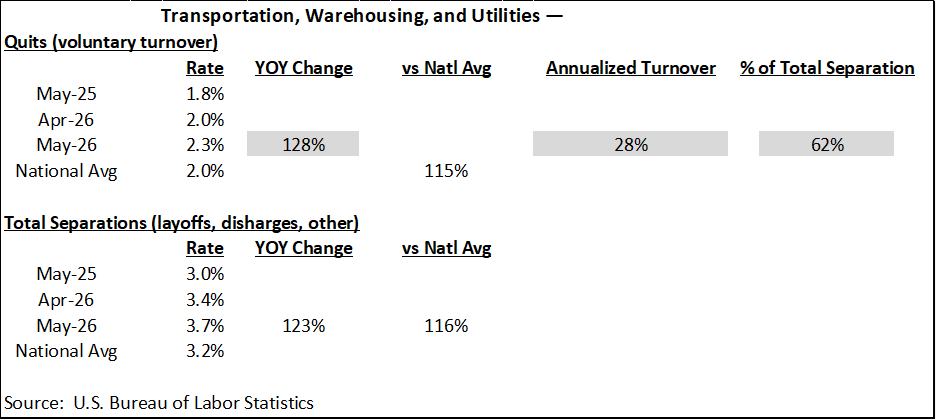
May 26' voluntary turnover was 2.3%, implying an annualized turnover rate of 28%, meaning:
- More than a quarter of logistics workers are quitting this year.
- Quitting accounts for nearly 2/3 of all separations.
- Quitting this year grew in comparison to all other sources of separations.
In an industry burdened by physical and safety training requirements (forklift certification, PPE, and DOT compliance for drivers) most studies peg the cost of new hire training in logistics at $4500-$6000 … a far steeper penalty than a $200 one playing a Monopoly game.
Why do people quit?
There are several well-known studies that attempt to answer the question using information gathered from Exit Interviews:
Pew Research Center - one of the most cited large-scale surveys, surveying workers who quit in 2021.
McKinsey - research, often cited in HR literature.
Gallup - research frequently cited by HR consultancies.
MIT/Revelio Labs - a 2022 study, but still influential in 2026 analysis.
Here is a composite "top 5" reasons for quitting which show up consistently across these studies:
- Compensation — pay not keeping pace with market or role
- Management quality — feeling unsupported, not cared for, or poorly led
- Career growth/stagnation — no visible path forward
- Work-life balance / flexibility — including both scheduling and remote/hybrid friction
- Culture/respect — feeling undervalued or misaligned with company culture
One important caveat on the data itself: academic research performed by Giacalone and Knouse found that exit interviews tend to underreport manager and culture-related reasons for leaving, because departing employees often soften the real reasons they are departing when speaking directly with HR.
Knowing 2 of the top 5 most commonly cited reasons for quitting are probably under-reported should feel like a fire alarm. It sure does for me.
What can Work Done Better Consulting do to help you?
Work Done Better has led or consulted 40 distribution and fulfillment centers for Fortune 500 companies, manufacturers, 3PL providers, start-ups, and turn-arounds ... in both non-union and union shops - and we have helped those teams produce a 25% improvement in productivity; a range of +11% to +44%.
40th place improved 11% - in less than 6 months.
I doubt many reading this blog have 2026 financial budgets that require an 11% improvement in productivity for their facility/facilities.
My point is this - the 25% average productivity improvement achieved by the 40 facilities I've either led or consulted is nearly enough to totally offset the negative impact of the current 28% turnover found across warehousing and transportation ... all done in a 'work done better' culture where:
- The workplace is dominated by measurement and KPIs
- Where hourly workers set the goals for their specific department/shift
- Where teams of workers decide how they will celebrate hitting the new goal within a celebratory budget
- Where teams establish goals and celebrations for 4 dimensions of performance: Safety, Productivity, Accuracy, and Speed/Service
- Where supervisors are required to give each and every worker performance feedback weekly, in person, and a log maintained documenting these conversations.
I'll admit, I have never measured improvements in reduced turnover - I just know it has gone down, by a lot in several cases.
That generally doesn't concern me as my experience doesn't observe +25% improvements in productivity coexisting with rising worker dissatisfaction and turnover risk.
However, I will gladly measure those results in the next consulting engagement.
The Work Done Better Consulting Engagement Model
- Hire me for 13 weeks, for $100 per hour plus travel.
- I will cap consulting fees at $5000 per week, or $65,000 for the engagement.
- If your operation is not >10% more productive at the completion of 9 weeks, I will cut my fees 50% for the last 4 weeks, reducing the cap on fees to $55,000
I average saving my clients $345,000 for every 100 production workers.
100 workers making $15/hour at a 15% benefit load is an annual payroll of $3.6 million.
- A 10% annualized productivity improvement saves you $360,000.
- A 25% annualized productivity improvement saves you $900,000.
Both present an attractive ROI for a $55,000/$65,000 investment.
The Cost of Turnover
For logistics employers:
- For every 1000 workers employed, companies are losing 280 of them this year, at a re-hire/re-train cost of $1.4 million.
- If you employ 250 workers, you stand to lose 70, at a cost of $350,000 - or, $1400 per your original 250 workers.
- If you implemented a gain-share or incentive plan, that provided for payments of $250 per quarter or $1,000 a year if a goal to reduce turnover by 25% was met ... and the team met the goal, you would pay 198 retained workers $198,000, but avoid new hire costs of $5000 x 18 = $90,000.
- At $15 per hour and 15% benefit load, the payroll for 198 workers is $7.1 million. The productivity of your operation need only improve 1.4% to save the other $108,000.
Do you think if you reduced turnover by 25% that you would accomplish that?
I do.
Or, you can hire Work Done Better, and we will help you accomplish much more.