Intent - a Compass for High Performance and Agile Teams
Organizational agility is a commonly cited corporate goal, but a capability few ever attain.
There are many reasons for this being true.
Agility isn’t a byproduct of control, policy, incentive plans, or to a large extent – even, process.
Rather, agility is a function of intended outcomes and empowerment. The path becomes secondary to the destination.
There are many ways to get to the mountain top.
Agile teams have developed the ability to anticipate the actions and intentions of others – whether it be the boss, the customer, your workers, instead of simply reacting to the things they say or do.
You move faster. You gain advantage. Your business wins.
Agility is developed … over time, with practice, enabled by trust – and guided by an understanding of intent.
When everyone understands intended outcomes and their importance to the overall mission; they are best able to respond to unforeseen circumstances and make quick and decisive adjustments to accomplish the mission. This opens the door to latitude and freedom of action, which often yields more positive results than you ever contemplated.
In the heat of the battle, your team can’t always wait for your permission to act.
I learned this as a green Army Lieutenant on my first assignment in Europe 40 years ago.
I was commissioned an Army Infantry officer upon graduation from Wake Forest University. After being trained as a junior leader at the Infantry School at Ft Benning, Georgia, toughened at Airborne School, and refined as an Army Ranger – I was shipped to my first duty station; a mechanized infantry battalion in Germany in the mid-1980’s.
The Cold War was in full swing, Ronald Reagan was President, and the Berlin Wall separated Germany. The US military stationed in Germany had a real-world mission to defend West Germany from any Russian/East German aggression or attack.
Our defensive battle plans identified key terrain in both urban and rural communities, where we regularly deployed for the purposes of reconnaissance, rehearsal, and to increase our familiarity with the area’s terrain, available resources, and the enemy’s likely avenues of approach.
The US mission to defend Germany’s sovereignty was seen as so essential that the government and citizenry authorized (or endured) armored forces training and rehearsing our tactics and plans by performing off-road maneuvers across the public and private land we were assigned to defend.
Much of this privately held land was farmland – which was subject to damage by our 50,000-pound armored vehicles as we drove across it. There was a process to document this “Maneuver Damage” and financially recompense land owners. Their vested interest in a capable defense came at a cost – but for which they were generously repaid.
I didn’t fully appreciate the connection at the time, but the realism of our mission-specific training not only sharpened our armored infantry tactical expertise, but also served to develop my leadership skills, and teach me a thing or two about the power of statements of intent.
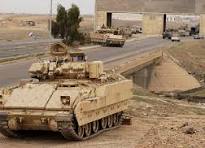
As a Lieutenant, you led a platoon of 40-45 soldiers, in four squad-sized units of 9-12 soldiers. Each squad was assigned an armored personnel carrier “APC” … later, a Bradley Fighting Vehicle … from which they maneuvered and fought while protected by its specialized armor and hardened steel.
Deploying ‘to the field’ provided the training opportunity to practice orchestrating the movements of your 4 APCs; usually while observing “radio listening silence” – which was important to avoid creating an electronic signature that the enemy could use to pinpoint your location.
This meant you learned and relied on alternative methods of communication, like using hand and arm signals or flags, to issue commands and orchestrate movement.
Communication was further complicated by the need to maintain a distance between each APC so that no single blast could strike and damage more than one vehicle.
These methods and constraints implied a few things:
- You communicated in brevity … there is no sentence structure in a hand signal
- Line-of-sight had to be maintained
- Your team had to develop a mutual understanding of what was meant … or intended by these visual signals.
Surely, the phrase “crawl, walk, run” was invented in a field somewhere in Germany by a Lieutenant trying to exercise command and control over 4 armored vehicles moving hundreds of meters apart while not being able to issue verbal commands.
It was difficult, and prone to error and misinterpretation.
One important tactical maneuver a platoon had to master was called “Bounding Over-watch” which involved committing only a small part of your force forward into unsecured territory as a precaution because of the uncertainty of the enemy’s exact whereabouts. For a platoon, this meant a single APC/squad would move forward alone (ideally using covered terrain to do so) until they reached a vantage point (again, ideally one providing cover) from which they could provide “over-watch” while the remaining vehicles came forward. You did this repeatedly in ‘bounds’ until you either reached your destination or made contact with the enemy.
Invariably, I’d have that first APC not use what I considered the best route forward, stop at what I considered the ideal over-watch position – or even stop at all sometimes - and vanish over the horizon … which of course would be a minor breach of the rule to maintain visual contact.
You were left mumbling to yourself, “Ah … We can’t see you anymore, Sargent Smith!”
At times, it was a downright painful process …
You were left waiting and hoping in silence for the recognition something was amiss, and for the APC to return where you could see each other again.
At the end of a training segment, we would gather and hold an “After Action Review” (AAR) to draw out learning for future improvement.
As a young leader I found these AARs were best conducted using a dose of restraint and carefully chosen words to preserve a healthy learning atmosphere.
Questions like, “What the hell were you thinking?” tended to work against that goal.
In time, we improved, as it did when I commanded a light infantry company in the late 80’s.
The proof of the power of intent came on a real-world mission to Honduras in 1986. My unit was deployed to Honduras as part of Operation Golden Pheasant and one night I issued the following order to one of my platoons; “Move to Hill 100 and prevent infiltration forces from crossing the bridge at grid point 123456.”
When the platoon arrived at Hill 100, the vegetation was so thick it prevented observation of the bridge.
I’m told a brief internal debate ensued … with some leaders suggesting they radio and ask for clarification, but the lieutenant relied on the intent of the mission – which was to prevent enemy forces from crossing the bridge.
“If we can’t see the bridge from Hill 100, we need to quickly determine the best place where we can accomplish that, and move … quickly”.
So, they did - and in the next hour were able to convince a Sandinista patrol to turn around.
You don’t have to wear camouflage to make Intent work for you.
Leadership lessons learned while leading soldiers continue in their application today, like:
- Don’t ask people to do something you are not prepared to do yourself
- Issue guidance in terms of both task and purpose
- Don’t just tell people what you want accomplished, tell them why it’s important
- Make sure everyone understands the big picture and your overall intent
Team’s that operate in this manner are well on the way to the mountain tops of their industry.