The Forgotten Middle

Long before an executive ever sees a quarterly report, a front-line supervisor has already made a hundred decisions influencing safety, service, productivity, and retention – and whether the numbers on that report will be good or bad.
Supervisors translate strategy into daily execution by converting leadership’s goals into specific tasks, assignments, schedules and standards teams can follow.
They break down targets into shift-level or hourly goals.
They keep the team focused on what matters most each day.
The very best supervisors adjust plans in real time as conditions change.
Across the 40 distribution and fulfillment centers I’ve led or consulted; I’ve had the opportunity to lead and develop the skills of more than 900 front-line supervisors.
I’ve learned quite a bit along the way and offer a few of those lessons here.
Vantage Point
I’ve devoted more time to supervisor training than any other task as a logistics executive, because of a leadership principle I first learned while leading as an Army Infantry officer:
Leaders should position themselves where they can best influence the action.
George Washington understood this, which is why he positioned himself in the lead boat crossing the Delaware in the attack on Trenton in 1776; visibly with his troops for the riskiest part of the operation.
Herb Kelleher (Southwest Airlines) famously spent time with baggage handlers, flight attendants, and gate agents to see morale and process problems first hand.
Toyota's "Genchi Genbutsu" ("go and see") — a core principle of the Toyota Production System, holds that leaders and engineers must go to the actual location where the work happens to understand a problem, instead of relying on after-the-fact reports.
These leader choices share an underlying theme: a leader should trade comfort or safety in order to gain proximity to where outcomes are decided – because information degrades and slows the further a leader is from the action.
In our distribution and fulfillment centers, and warehouses supervisors hold the keys to safety, productivity, accuracy, speed … employee retention … and whether the ideals of an intended culture exist either on a bulletin board or in practice.
This is why I have devoted the majority of my time - and created a consulting business – focused on enhancing the skills of front-line leaders.
If we ensure our supervisors have the information, skills, training, and resources they need, they will reward us by seeing to it that the job is performed well, and continuously improved.
It is simply the best way to positively influence the performance of the facilities we lead – without a dollar of capital being necessary.
Span of Influence and Structural Habit
Front-line supervisors in high-standardization environments like warehouses, fulfillment centers, and assembly lines typically manage 15-30 people, with 20-25 being a common midpoint.
Those teams are typically only gathered for succinct start-up meetings, announcements, group training, and special events. Therefore, the most common way individual workers receive coaching and feedback is through one-on-one discussions with their supervisor.
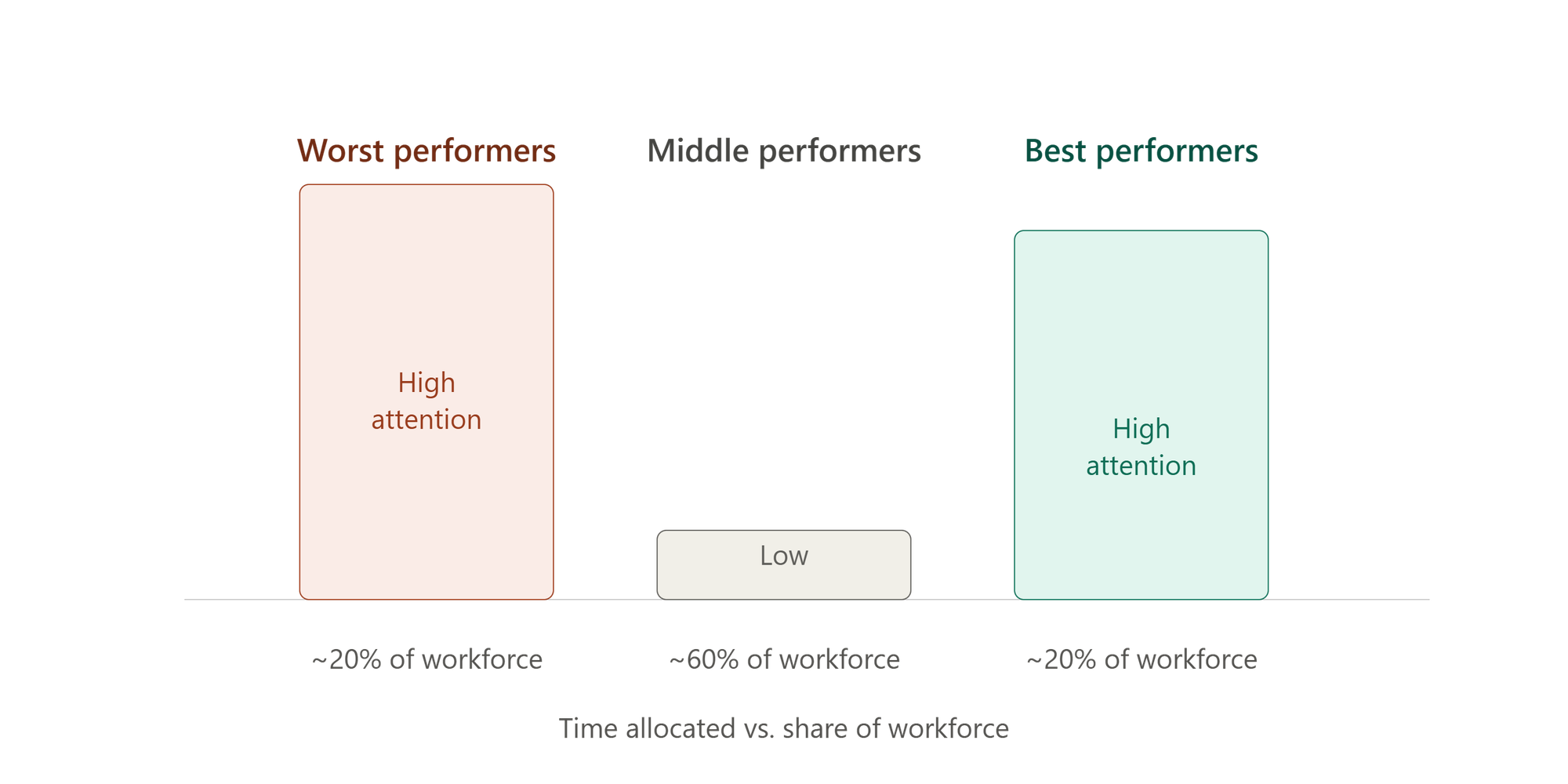
Early in my career, I began to notice that supervisors tend to spend a disproportionate amount of time on either their best or worst performers.
Call it human nature.
Where top performers are concerned, it’s a good-news conversation … quick, easy, reinforcing and in the supervisor’s best interest to make sure their top performers are thanked.
For the bottom performers, the conversation may be less desirable, less positive, but necessary due to policy, production standards not being met, and because those individuals are pulling down the team result … so fellow workers expect their supervisors to take action.
But I noticed that left nearly 60% of the team lacking regular performance feedback.
The forgotten middle: why supervisors focus on the extremes
Ask a front-line supervisor how they spend their day, and most will describe firefighting — chasing down a quality problem here, coaching a struggling worker there. What they won't usually mention is who they didn't talk to: the solid, steady majority of the team.
This isn't laziness or favoritism.
It's structural.
Poor performers generate visible problems that demand immediate attention — missed targets, safety incidents, quality defects.
Top performers get pulled in for different reasons: they're trusted with harder tasks, informally groomed for promotion, or simply more rewarding to work with.
Middle performers, meanwhile, don't draw attention to themselves. No crisis, no opportunity — just quiet, unremarkable output that never forces its way onto the supervisor's radar.
The result is a workforce where roughly 60% of people — the ones actually driving the bulk of output — get a fraction of the coaching attention.
That is a costly blind spot.
To test this theory, I began asking my supervisors three questions:
- Who are your top few workers?
- Who are your worst few workers?
I found that supervisors can readily cite the names of their top several workers. They also typically knew more about these workers on a personal level, like their interests, their families, who they socialize with, their favorite teams, etc.
When you ask who their worst workers are, I found supervisors take a bit more time answering the question, as if they were really thinking hard about it. Then, nearly as quickly tell you the names of their 2-3 problem performers.
But my supervisors were less familiar with this second group of people, and noticeably less aware of their outside interests. It seemed clear they spent less time with these people.
Try this for yourselves.
If you do, you will now have surfaced the names of 30-40% of the team your supervisor leads.
Now, give the supervisor a pen and paper and ask question 3:
- Can you list the names of everyone else on your team that you haven’t already mentioned?
You’ll be there for quite a while.
Mind you, I’m not saying this is universally true … the best supervisors may be able to easily list the names of their entire team. But I found many struggled to do so.
Which then begged the questions … What did this reveal, and what was I going to do about it?
We have a vested interest in ensuring all of our workers receive the training and coaching necessary for them to do their jobs properly and continuously better - especially since moving average performers up is usually higher-leverage for overall productivity than perfecting your top performers or salvaging every low performer.
Organizations that solve this tend to do it deliberately, not organically — for example, requiring every worker get a scheduled 1:1 check-in each week, regardless of performance tier …
And, that’s what I did.
I purchased “Month at a Glance” planners for my supervisors; the kind that have lines to enter each team member’s names down a left column, and boxes to the right – one for each day of the month … the kind of book our teachers used in grade school, to keep track of when students were absent (A) or tardy (T) and to record test scores, quiz scores, and extra credit work.
I set a few expectations for the book’s use:
- Supervisors were to record the nature of a coaching discussion with a worker on their performance, using abbreviations for positive (+), negative (-), a % to standard, etc.
- Copies of the day prior’s production or labor management report were to be kept with the book for ready-reference in these conversations.
- All team members were to receive coaching once per week at a minimum.
The books then became an auditable record of coaching conversations, frequency, and nature.
With the book and report in hand, when a supervisor stopped by an employee’s work station, the worker began to understand they were about to have a conversation about their work performance, and that the supervisor was keeping a record of doing so.
The books became an “antecedent” not just for performance feedback, but for performance – period.
A couple of surprising things began to happen:
- First, if a worker knew they had a really good day the day before, and their supervisor was about to walk by them without stopping to recognize that, they often stopped the supervisor and asked, “Hey, how did I do yesterday?”
People wanted to be recognized.
- Second, while some supervisors expressed reservations about the books; complaining it was just “one more thing they had to do” … when “review time” came around suddenly the books became their best friend – providing a ready and well documented record of team member’s work performance.
- Contentious reviews nearly disappeared. Gone were the objections of people being evaluated as “needs improvement” or asserting they had no idea they were not meeting expectations … because if they tried, a supervisor was able to flip through the last ‘x’ months of records and show all the documented conversations about the person’s performance. The books backed up a supervisor’s assessment.
Additionally, when managers or I asked to check their books, a quick review gave us the opportunity to positively reinforce a supervisor’s diligence, distinguish high performing supervisors, and give us line of sight to individual team members deserving of recognition.
It also telegraphed where there were avoidance relationships needing of repair.
Work Done Better Consulting
Work Done Better Consulting has a track record of averaging a 25% improvement in productivity across the 40 facilities where we have had engagements (a range of +11% to +44%).
Finding a way to orchestrate regular coaching and performance feedback for the “forgotten middle 60%” is central to that success.
Please contact me if you’d like to discuss this further, or get an engagement started in one or more of your facilities.