Artificial Intelligence (AI) - In Search of a widespread "PIC"
Businesses are rapidly adopting AI, but many are struggling to harvest AI into real, scalable outcomes. Unclear financial returns (ROI), poor data quality, security risks, and legacy system integration issues are just a few of the most commonly cited obstacles to full implementations.
Less cited, but a major barrier to AI implementation is Workforce Skill and Behavior.
In a 2025 study by Statista, the biggest barriers to AI adoption were the lack of skilled professionals (cited by 50% of businesses), a lack of vision among managers and leaders (cited by 43%), followed by high costs of AI products and services (29%).
AI’s high investment cost leads to a reciprocal requirement for high savings ... and most every corporate call for cost reduction inevitably leads to headcount rationalization.
Corporate Head Count reviews produce worker anxiety, mistrust, and a fear of displacement. Perhaps especially with AI, concern over the inevitability of displacement leads to disruptive acts of self-preservation, including voluntary turnover of the very people the business is counting on for solid implementation and improved productivity.
In a world where human behavior is shaped by the consequences we receive for the way we behave, and some consequences influence future behavior more strongly than others – it doesn’t take a genius to figure out there may be some reluctance on the part of workers to function as co-conspirators of their own pink slips.
So, here we are … 3 years in to the march to AI and stories abound of company’s investing millions of dollars on AI, the pilots looked strong, the demo worked, and then the results have flat-lined.
The problem is not the model.
The problem is people, process, strategy, and human behavior.
The Behavior Chain
Human behavior is influenced by those things that precede behavior and set expectations for how to behave, called Antecedents … and those things that happen to us because of our behavior, called Consequences. These elements form a relational behavior chain:
Antecedents – Behavior – Consequences
Antecedents include training, policies, laws, signs, slogans, and even consequences we observe being applied to others. Antecedents only have a short-term influence on the way we behave.
Behavior – are the things we say and do. Behavior can be observed, and therefore measured, and everybody's behavior makes sense to themselves.
Consequences – are those things that happen to us because of our behavior.
Consequences should be viewed from the performer’s perspective, and can be classified across three dimensions. Consequences are either:
· Positive or Negative
· Immediate or Future
· Certain or Uncertain
These consequence-combinations alter the probability of seeing a repeat in the observed behavior, with some combinations influencing our behavior more strongly than others.
The most influential combination of these is POSITIVE / IMMEDIATE / and CERTAIN; or “PICs”.
When something happens to us because of the way we behave and that something is: POSITIVE, IMMEDIATE, and CERTAIN … the probability of a repeat in that behavior increases, or as I like to say at Work Done Better:
The single greatest predictor of something good happening again is when it is positively reinforced when it first occurs.
We’re all different. Things that I consider positive may be viewed differently by others, and vice versa.
Consider a scenario at work, where a supervisor attempts to recognize workers by announcing their birthdays publicly in a team setting. Some or most employees may regard this as a sincere and positive thing, while a co-worker who associates their birthday with some form of trauma may wish for the day to pass unnoticed, or even consider such an announcement to be a violation of their privacy.
We’ve Seen this Movie Before
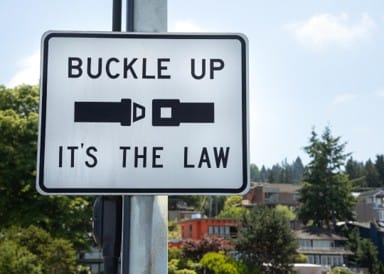
In the mid-1970’s the automobile industry and government faced a very similar obstacle overcoming an array of positive consequences which were encouraging drivers and passengers to disregard laws and media campaigns to Buckle Up, and instead NOT wear their seat belts.
At the time, people dressed more formally for work. Men wore ties, jackets, dress shirts and slacks. Women wore more dresses, skirts, blouses and blazers.
Working against seat belt use were the positive consequences people readily experienced when they did not buckle-up:
- I am more comfortable
- I won’t wrinkle my clothes
Both of these were powerful Positive / Immediate / Certain consequences.
Antecedents such as billboards, TV commercials, and radio all warned, “If you don’t use seat belts”:
- I risk serious injury or death
- I could receive a ticket
These were each Negative things, but also very Future and Uncertain, so carried little weight.
All the “Public Service Announcements” (Antecedents) in the world didn’t change behavior.
I remember being in the car with my dad in the 1970’s and he’d go to great lengths to not buckle up; his favorite ‘work-around’ was fastening the seat belt behind him to fake out the car’s new safety features.
As a result, seat-belt use flat-lined, and more people were hurt or killed unnecessarily ... despite mounting evidence that seat belt use would help prevent injuries or death in the event of a serious accident.
BUT THEN - the auto industry stumbled upon how to create a POSITIVE / IMMEDIATE / CERTAIN "PIC" consequence for the behavior it sought – for people to fasten their seat belts …
The Chime or Buzzer in the car STOPPED!
Over time, driver and passenger behavior has changed – and last year over 91% of drivers and passengers reported using their seat belts.
This all suggests a path to improved AI implementation – but one that seems dependent on a comparable Eureka! Moment / “PIC” being discovered for the AI industry -
What could possibly function as a widespread Positive / Immediate / Certain consequence for AI implementation?
I expect the answer may come from within the Daily/Weekly/Monthly/Annual planner industry.
I don’t believe engineering a nuisance into the workplace so AI use turns it off is likely to work today.
How Work Done Better Consulting Can Help
I have now led or consulted 40 distribution and fulfillment centers in my career, and these teams have averaged improving productivity by 25% … a range of +11% to +44%:
- Without a $1 of invested capital required
- Saving an average of $350,000 per 100 workers
WDB Consulting offers a systematic approach to training your leaders on human behavior and guiding them through a repeatable process of measurement, goal setting, providing team and individual feedback and coaching, celebrating, re-establishing new goals, and transitioning to multi-dimensional excellence where teams are striving to improve safety, quality, accuracy, and speed within every department/shift team.
This approach:
- Creates savings which can be invested in AI or other technologies
- Increases productivity beyond typical turnover rates, so you are literally on the path of producing more with less.
- Increases the engagement of workers, who now become more willing to embrace the kind of change a technology like AI encompasses.
Please contact me if you’d like to discuss how we can help you.